Over the past fifteen years, the bank-business relationship has changed little : thanks to their banking communication platforms, companies have exchanged information with their banks via classic protocols: secure FTP, SWIFT, ETEBAC and then EBICS.
The rule established by the second Payment Services Directive (PSD2), which came into effect in September 2019, has changed this landscape: it requires banks to provide open APIs to authorize access to account information and initiate payments. As NEOFI Payment , the banking communication platform must leverage this new secure communication channel without abandoning existing ones. Businesses thus remain free to choose the most easily accessible channel to connect to their various banks. Depending on the features of the open APIs, this channel offers greater speed and fluidity, both during deployment and in daily use.
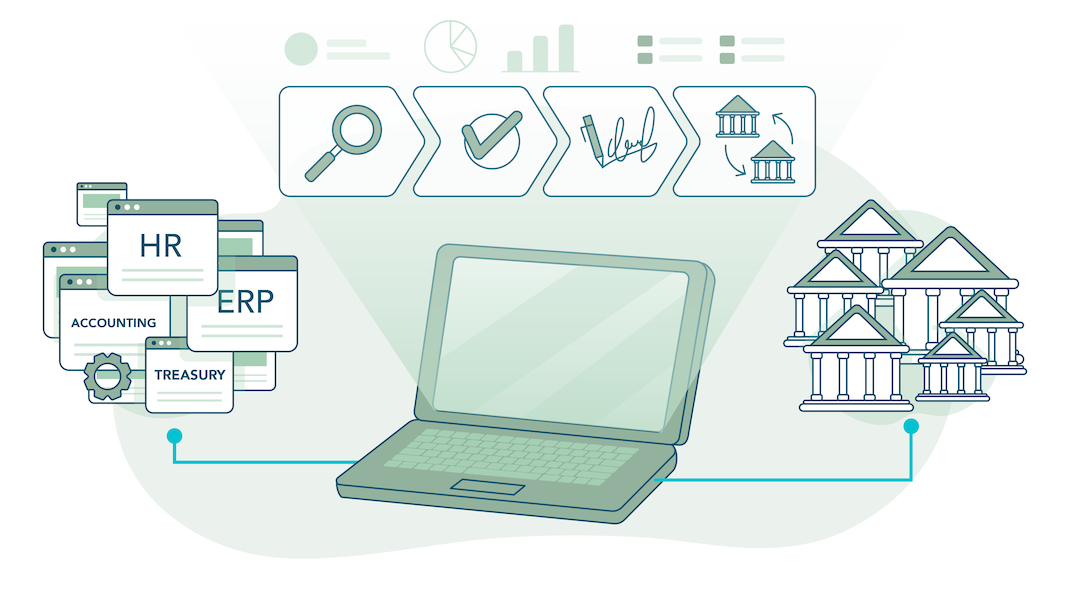
The banking communication platform interfaces with business applications (accounting ERP, HR information system, expense management application, etc.) from which it receives payment and direct debit files and to which it transmits transaction notifications, intraday reports, and account statements. It provides the security, centralization, and auditability essential for managing these sensitive flows. The most recent platforms now offer the ability to exchange data via APIs, making exchanges more secure and more precisely manageable. Thus, as is the case with NEOFI Payment , the banking communication platform must offer all exchange methods, from the most recent to the oldest, and must even ensure that each of its actions (control, validation, signature, etc.) can be accessed via web services; this new exchange method therefore has a bright future!
The seamless data exchange enabled by APIs isn't the only feature of this banking communication strategy . To this new method of information exchange and data collection, NEOFI adds a business intelligence (BI) module, which expands its compilation and analysis capabilities. Collecting data is good, but being able to analyze it is even better. Often criticized for its complexity, BI software is designed here for easy configuration. It's no longer enough to simply extract unreadable data into a table or display its evolution on curves or graphs; the goal now is to offer insightful and clearly presented information derived from the inspection of even the smallest data cell!
New features that we will have the opportunity to present in more detail in a future article...